BlogsPart 2 of 5
Why Do Competitive Programming?
Placements are a fine reason to start. Here's everything else that keeps people coming back.
By Dhruv Kumar & Aarav Bhatia · 4 min read
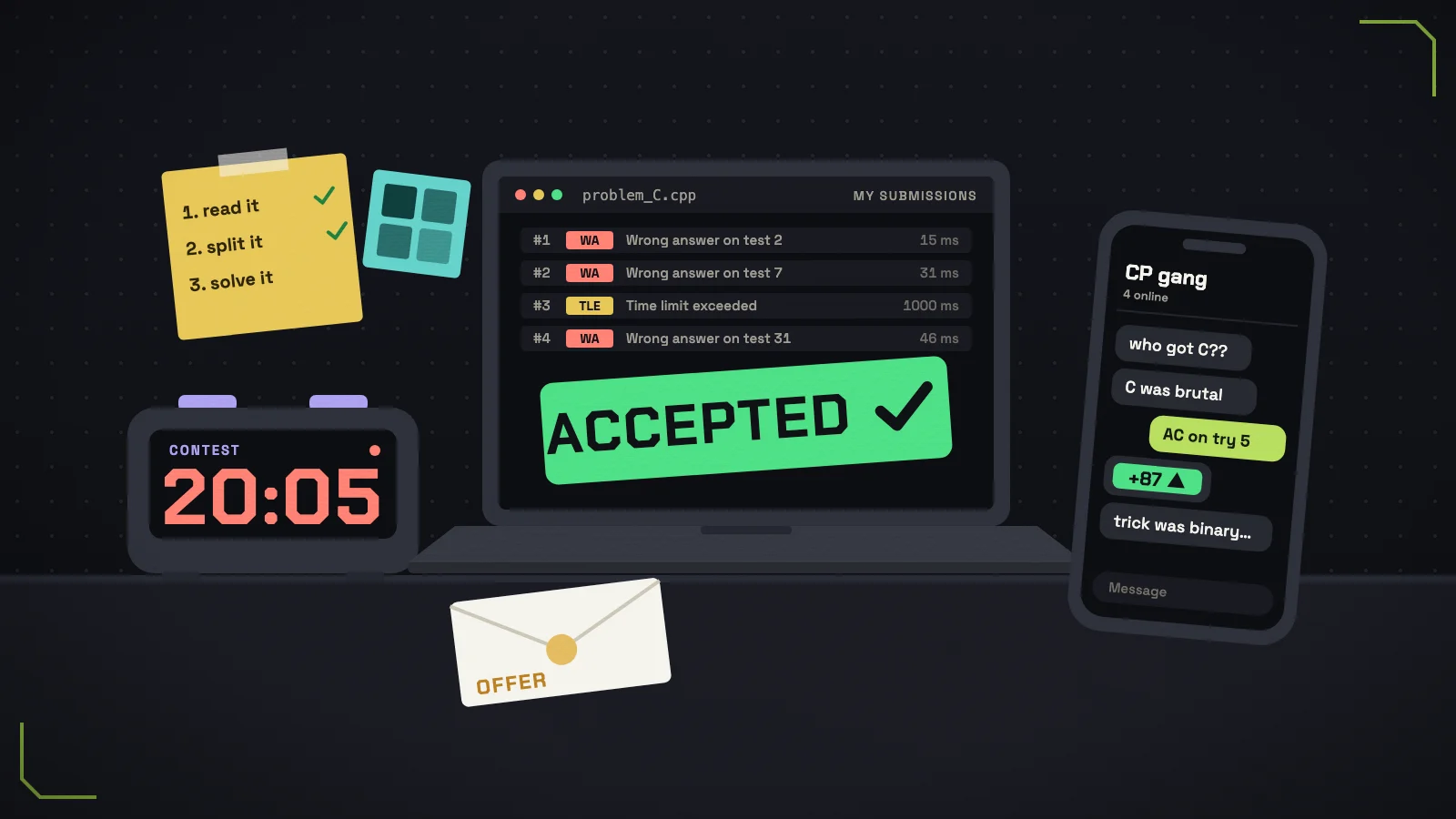
Ask around college why people do CP and the answer you'll hear most is "placements". That's a good reason to start, but it isn't what keeps most of us going, so here's the rest.
Yes, It Helps With Placements
Coding interviews lean heavily on DSA, and CP builds that foundation almost without you noticing.
You get used to unfamiliar problems under a ticking timer, so online assessments feel familiar by placement season.
CP isn't the same as interview prep, but the two overlap a lot.
It Changes How You Think
The bigger change is harder to put on a resume. After a few months you stop panicking when a problem looks impossible, because you've learned to break it into smaller pieces.
You start spotting patterns, where a new problem turns out to be an old one with a different story. Enough Wrong Answers teach anyone to think through a few approaches before typing.
It makes you a better programmer too. After a few TLEs you care about efficient code, you check edge cases out of habit, and you find your own bugs faster. That carefulness follows you into daily life.
Then the Contests Get You
Still, what gets people setting alarms for contests is the competition itself. A Codeforces round puts you alongside thousands of programmers worldwide, all on the same problems at once.
Watching your rating climb from Newbie to Pupil to Specialist feels like levelling up in a game, and getting AC after a string of WAs is a relief I can't describe.
Contest 1 of 14870
NewbieIt's better with friends, because the group chat after a contest fills up with rating screenshots, complaints about problem C, and someone explaining the trick everyone else missed.
There are bigger stages too. In the International Collegiate Programming Contest (ICPC), the best-known contest for college students, you compete as a team of three sharing one computer, dividing up problems, arguing over ideas, and trusting each other's code.
Solving something hard as a team feels different from solving it alone, and plenty of other intercollegiate and international contests let you do it.
You Won't Be Doing It Alone
CP introduces you to people who enjoy problem-solving as much as you do. You find teammates, learn from seniors who were stuck on the same things last year, and one day catch yourself explaining something to a junior.
The Somaiya Codes leaderboard shows where you stand on campus.
It Will Also Humble You
I won't pretend every submission comes back Accepted. You'll get stuck for an hour on a problem your friend solved in ten minutes, and some contests will drop your rating and make you avoid Codeforces for a week.
What you get out of that is patience. You learn to sit with a hard problem, to work out what went wrong after a bad contest, and to keep practising every week even when improvement is too slow to notice.
And Honestly, It's Fun
This is the reason I'd have put first if I weren't trying to sound sensible. Few things match solving a problem that looked impossible an hour ago, or finding the clever trick that turns fifty lines into five, and the green Accepted never stops being addictive.
Submitting…
Somewhere along the way, for a lot of us, CP stopped being something for the resume and became a hobby.
Not everyone who does CP needs to become a Grandmaster or qualify for ICPC. Some people do it for placements, some for the competition, and some simply because solving problems is fun. Whatever your reason, there's something to gain from giving it a try.