BlogsPart 3 of 5
CP vs DSA: What's the Difference?
Two things everyone mentions in the same breath. How they overlap, how they differ, and which to do first.
By Dhruv Kumar & Aarav Bhatia · 5 min read
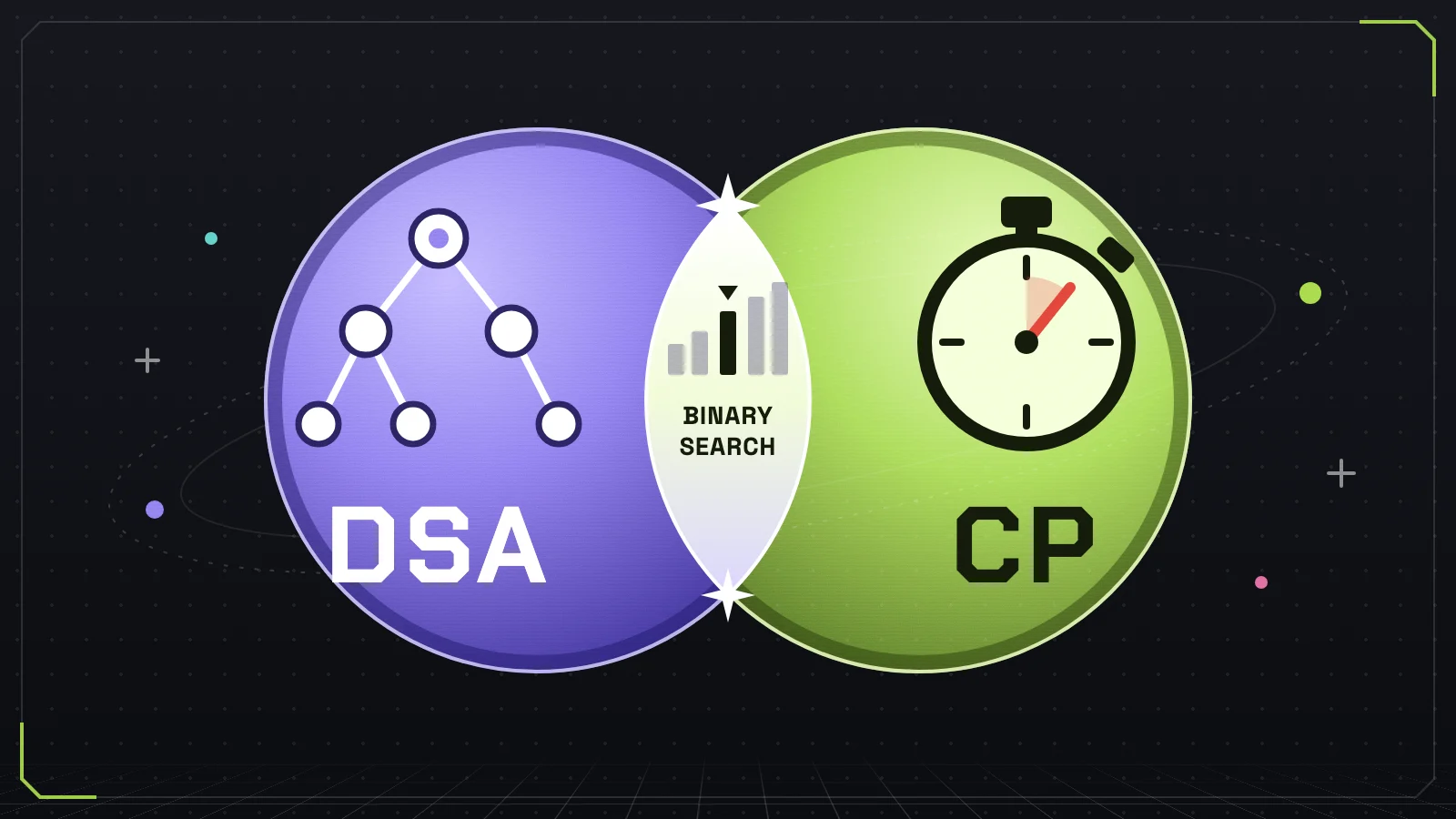
In college, you'll often hear someone say they're learning DSA, while someone else is busy doing CP. And then there are people who have no idea what either of those means, lol.
I think one of the most common confusions beginners have is whether CP and DSA are two completely different things.
Well, they're closely related, but not exactly the same.
A lot of the concepts overlap. Competitive programming takes those concepts and adds competition, time pressure, and a little more unpredictability.
Let me explain.
First, What Is DSA?
DSA stands for Data Structures and Algorithms.
Data structures are ways of organising and storing data efficiently. Think arrays, stacks, queues, trees, graphs, and so on.
Algorithms are step-by-step methods for solving problems. Sorting, binary search, BFS, and DFS are all examples.
Basically, DSA gives you the tools to solve computational problems efficiently.
Input sizen = 1,00,000
- O(log n)binary searchAC · instant17 steps
- O(n)one passAC · instant105 steps
- O(n log n)sortingAC · 0.02 s1.7 × 106 steps
- O(n2)every pairTLE · 2 min1010 steps
- O(2n)every subsetTLE · never21,00,000 steps
the one-second limit
And these tools aren't exclusive to competitive programming. They're useful in software development, technical interviews, and pretty much anywhere efficient code matters.
So, Where Does CP Come In?
Competitive programming is where you put your problem-solving skills to the test, usually in timed contests.
You're given a set of problems, and your job is to solve as many as possible within the time limit.
You'll use DSA, maths, logical reasoning, and sometimes tricks you've never seen before.
Interview DSA
CP
- Linked lists
- LRU cache
- Design questions
- Arrays
- Sorting
- Binary search
- Hashing
- +5 more
- Number theory
- Constructive
- Ad-hoc tricks
- The clock
Pick a zone to spotlight it.
The biggest difference? Nobody tells you which algorithm to use.
You have to figure that out yourself. And trust me, that's easier said than done.
Sometimes you'll know exactly how to implement an algorithm but spend an hour figuring out whether it's even useful for the problem.
Knowing an Algorithm vs Knowing When to Use It
Let's take binary search as an example.
While learning DSA, you might study how binary search works on a sorted array, implement it, and understand why its time complexity is O(log n).
Now imagine you're in a Codeforces contest.
The problem doesn't mention binary search anywhere. Instead, it asks you to find the minimum possible value satisfying some condition.
You need to recognise that the condition is monotonic and binary search might work.
The answer is somewhere in 1 to 40. Press Guess.
And sometimes, you'll spend half the contest figuring out something that looks painfully obvious once you read the editorial.
I've had plenty of those "How did I not think of that?" moments myself.
That's the kind of thinking CP encourages.
Of course, you can develop this skill through regular DSA problem-solving too. The difference is that contests force you to recognise patterns without being told what topic you're practising.
Knowing an algorithm is one thing. Recognising when to apply it is another.
Does Doing CP Automatically Make You Good at DSA?
Not necessarily, but it certainly helps.
Solving CP problems exposes you to different algorithms and teaches you how to apply them in unfamiliar situations.
However, being good at CP doesn't automatically mean you've mastered every DSA concept.
And the reverse is also true.
You could know how to implement dozens of algorithms and still struggle with a Codeforces problem because you can't figure out which one to use.
And honestly, that's completely normal. I've seen problems where the solution is just a few lines, but figuring out those few lines is the entire challenge.
Understanding concepts and applying them are two skills that improve together.
So, What Should Beginners Focus On?
I think beginners often spend too much time worrying about whether they should finish DSA first or jump straight into CP.
My suggestion? Don't overthink it.
Start solving problems with whatever programming knowledge you have.
Encounter something you don't know? Learn it, understand how it works, and come back to the problem.
Learn a new algorithm? Try solving a few problems using it.
And don't spend months watching tutorials, collecting DSA roadmaps, and waiting until you feel completely ready. You'll probably never feel 100% ready anyway.
You learn problem-solving by actually solving problems.
At the end of the day, DSA and CP aren't two competing paths. DSA gives you the tools, and CP is one of the best ways to practise using them.
So instead of worrying about which one to choose, why not do both?
Learn. Solve. Get stuck. Learn something new. Repeat.