BlogsPart 5 of 5
Ratings, Ranks and Divisions: Codeforces vs CodeChef vs LeetCode
Colours, stars and badges, decoded. What your rating means on each platform, and why not to obsess over it.
By Dhruv Kumar & Aarav Bhatia · 5 min read
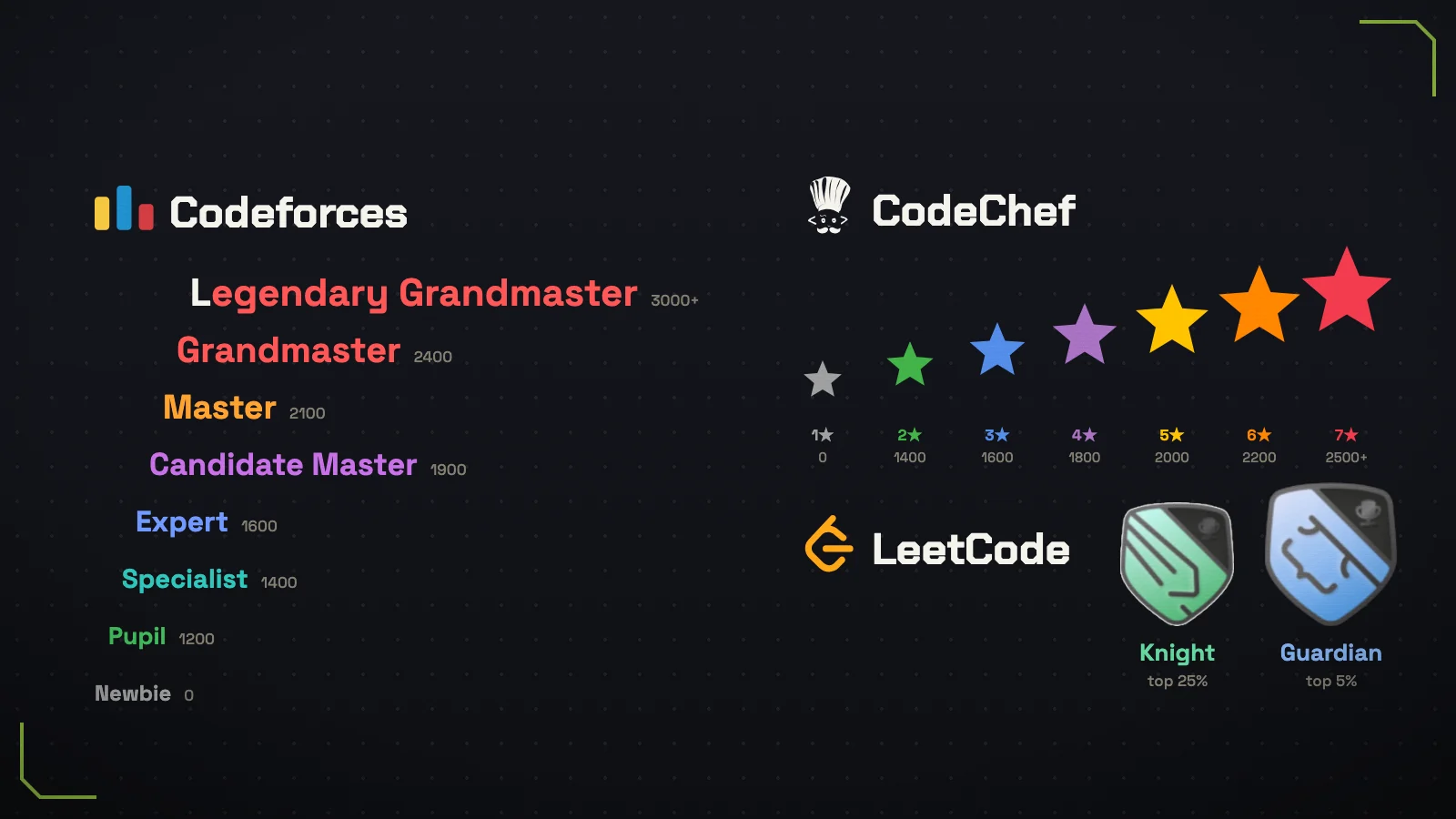
Your friend just became a 2-star on CodeChef, someone else finally turned green on Codeforces, and another person is celebrating their LeetCode Knight badge.
Meanwhile, you're wondering what any of these actually mean.
All three platforms have their own rating systems, ranks, and achievements. Let's break them down.
What Exactly Is a Rating?
A rating is a number that represents your performance in competitive programming contests relative to other participants.
Perform better than expected, and your rating generally goes up. Perform worse, and it might drop.
But don't confuse these three things:
- Rating: Your overall competitive performance.
- Contest rank: Your position in a particular contest.
- Problem rating: How difficult a problem is considered to be.
And no, solving 100 problems outside contests won't automatically increase your contest rating.
Codeforces: The Colour Obsession
On Codeforces, your rating determines your title and the colour of your username.
Here's how the ranks work:
| Rating | Rank | Colour |
|---|---|---|
| Below 1200 | Newbie | Grey |
| 1200–1399 | Pupil | Green |
| 1400–1599 | Specialist | Cyan |
| 1600–1899 | Expert | Blue |
| 1900–2099 | Candidate Master | Violet |
| 2100–2299 | Master | Orange |
| 2300–2399 | International Master | Orange |
| 2400–2599 | Grandmaster | Red |
| 2600–2999 | International Grandmaster | Red |
| 3000+ | Legendary Grandmaster | Red |
Codeforces also has different contest divisions:
- Div. 4: Generally the most beginner-friendly.
- Div. 3: A step up, aimed at lower-rated participants.
- Div. 2: More challenging, typically for intermediate competitors.
- Div. 1: Primarily for highly rated programmers.
Each contest specifies who can participate officially and whose performance will be rated.
And trust me, the excitement of finally changing your username colour is real.
CodeChef: Collecting Stars
CodeChef takes a different approach. Instead of coloured titles, you earn stars.
| Rating | Stars |
|---|---|
| Below 1400 | ★★★★★★★ |
| 1400–1599 | ★★★★★★★ |
| 1600–1799 | ★★★★★★★ |
| 1800–1999 | ★★★★★★★ |
| 2000–2199 | ★★★★★★★ |
| 2200–2499 | ★★★★★★★ |
| 2500+ | ★★★★★★★ |
CodeChef also divides participants into four divisions:
- Div. 4: Below 1400
- Div. 3: 1400–1599
- Div. 2: 1600–1999
- Div. 1: 2000+
Its Starters contests have division-specific problem sets, so you're generally competing against people around your rating level.
LeetCode: Ratings and Badges
LeetCode uses contest ratings too, primarily through Weekly and Biweekly contests.
Unlike Codeforces and CodeChef, it doesn't have rating-based contest divisions or a progression of coloured titles.
Instead, it has achievements like:
- Knight: For eligible users in the top 25% of contest ratings.
- Guardian: For eligible users in the top 5%.
These badges also require a rating of at least 1600.
For new participants, LeetCode uses a separate scoring system for the first five contests before transitioning to its regular rating algorithm from the sixth.
Can You Compare Ratings Across Platforms?
Not really.
A 1600 on Codeforces isn't equivalent to a 1600 on CodeChef or LeetCode.
Each platform has different contestants, difficulty levels, and rating calculations.
And solving the same number of problems doesn't guarantee the same rating change either. Your relative performance matters.
That said, you might hear people use an informal rule:
Codeforces Rating ≈ CodeChef Rating − 400
Drag the slider to see what a rating means on each side:
Codeforces
1400
Specialist
CodeChef
≈ 1800
★★★★★★★
4★ · Div. 2
Don't Obsess Over Ratings
Let's address something important.
With AI becoming increasingly capable of solving competitive programming problems, ratings can sometimes be inflated through unfair assistance.
So a high rating alone isn't proof of someone's actual problem-solving ability.
But that doesn't make ratings useless. If you're participating honestly, they're still a great way to measure your progress.
A bad contest doesn't mean you've suddenly forgotten how to code. Everyone has those days.
Focus on learning new concepts, solving harder problems, and becoming more consistent.
At the end of the day, your rating is just a number. Your actual problem-solving ability is what matters.
And remember, getting better at CP is the goal. The colours, stars, and badges will follow.